




Care – Repair – Resell – Rent
PFLEGEN
Die richtige Pflege eines Kleidungsstücks kann dessen Lebensdauer deutlich verlängern und für nachhaltige Freude sorgen. Wir geben dir einen Leitfaden mit auf den Weg, an dem du dich bei der Pflege deiner Kleidung orientieren kannst.
Schnelleinstieg
Wähle ein Thema
01/
Grundlagen
Beloved garments made of natural fibers like wool suddenly show them - those little knots called "pilling," which simply arise from friction on the surface. To remove pilling knots, you can use a lint shaver or cut them off with fine scissors. But be careful: if the knots are pulled off, the fiber can be damaged. You can brush up beloved garments with fine, long hairs from time to time.

Wash
Low temperatures and reduced spin speeds, as well as laundry bags for wool and silk, are highly recommended. Furthermore, it's best to wash your garments with similar colors and always inside out. Close all buttons and zippers to prevent damage during washing. Use bleach-free, liquid delicate detergents. They dissolve better than heavy-duty detergents and protect the fibers without compromising washing performance.

Ventilate
A wonderful and easy-to-follow care tip: Not every item of clothing worn needs to be washed immediately afterwards. Often, it's enough to hang your favorite piece on a hanger for half an hour to air it out. This not only saves time and water but also protects the environment and the material.

Iron
Ironing restores your favorite garments and smooths the fibers of fabrics that have been roughened by washing. Always follow the temperature instructions indicated on your garment. For special natural fibers such as silk, as well as natural-like fibers such as elastane, TENCEL™, and Lenzing™ EcoVero™, we also recommend placing a damp cloth over the garment and using a steam iron. Pro tip: Invest in a good ironing board cover, as the metal mesh of cheaper ironing boards can press through.
Steaming shapes the garment using hot steam. This care technique has the advantage that the textile fibers are not exposed to heat as intensely as they would be when ironing. Therefore, a steamer is an absolutely useful care tool if you want to care for particularly delicate fabrics.
02/
Materialpflege

Baumwolle
- Wash dark and colored textiles separately at max. 30 °C
- Wash special fiber blends only in the gentle program (delicates)
- Use special detergent for cotton
- Iron at moderate heat at max. 150 °C

Linen
- Only load the washing machine drum halfway, otherwise the linen fabric will wrinkle too much
- gentle wash cycle at max. 600 revolutions per minute
- Use special detergent for linen
- Do not dry in the sun
- Pull into shape and dry flat

hemp
- Pausen zwischen dem Tragen einbauen
- Regelmäßig lüften
- Auf links drehen und im Schonprogramm oder per Hand waschen (Etikett beachten)
- In Form ziehen und liegend trocknen
Gently dab small stains with a damp cloth and never rub them off
- Allow breaks between wearing
- Aerate regularly
- Wool wash cycle in the washing machine only at max. 20 °C and 400 revolutions (please note the label!)
- Use special detergent and laundry net
- Squeeze out in a terry towel after washing
- Store lying flat and dry
- For heavily soiled favorite items, give them to a professional gentle dry cleaner
- Remove knots with a lint shaver
- Use natural moth protection, e.g. lavender

TENCEL™ & Lenzing™ EcoVero™
- Wash at max. 30 °C and only use mild detergent without bleach
- When washing, ensure a low spin speed
- Do not dry in the sun
- Can be ironed with steam on low to medium heat

denim
When washing jeans, the rule of thumb is: as rarely as possible! Because with every wash, both the color and the material suffer. Over time, denim develops a characteristic look, such as wrinkles and personal color gradients, which are affected by washing too often.

silk
- Hand wash at low temperature: Wash inside out with mild silk detergent, using gentle movements in the suds
- Machine wash: Wash inside out at low temperature
- Iron while still slightly damp, with a cotton cloth in between
- Can be easily steamed with a steamer
Videoanleitung/
Leder
- Groben Schmutz mit einer weichen Lederbürste oder einem feuchten Tuch entfernen und niemals reiben oder kratzen, da irreparable Schäden entstehen können
- Leder mit speziell für die Lederart entwickeltem ökologischem Imprägniermittel und Schuhcreme behandeln
- Stark verschmutzte Lieblingsteile zur professionellen schonenden Trockenreinigung abgeben
03/
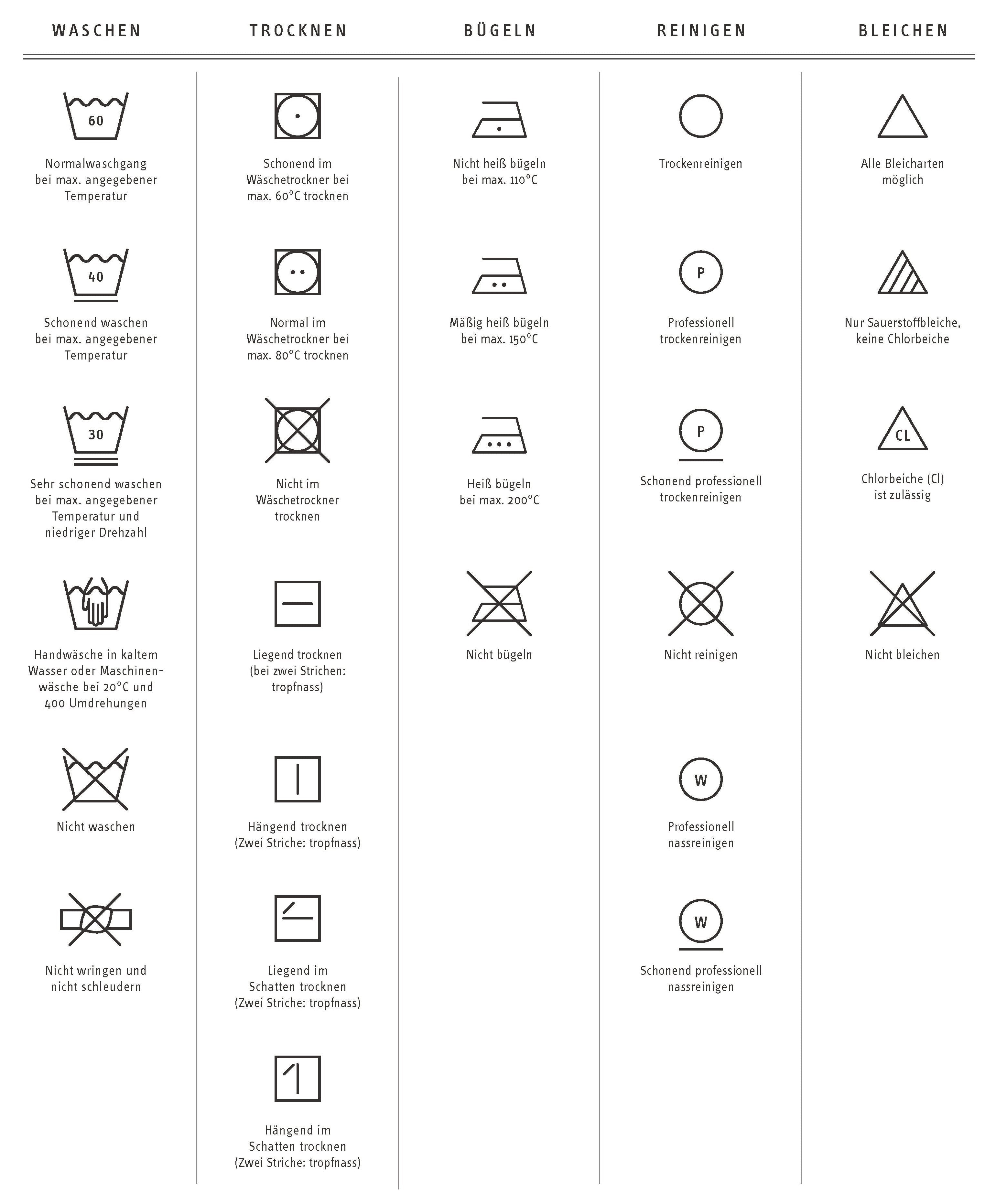
Pflegesymbole

04/
Flecken entfernen
Rotwein
Mit Wasser ausreiben und Salz (bei Kaschmir oder Seide: Trockenshampoo) auf den Fleck geben. Dann vorsichtig ausbürsten und waschen. Bei dunklem Schatten nach der Behandlung: Rasierschaum auftragen, einwirken lassen und auswaschen.
Coffee
Rub with mineral water or warm tap water. If the stain has already dried: put salt or baking powder on the stain and brush it out carefully. Gall soap can be used on light-colored and very insensitive items.
Fett oder Öl
Fett/Öl zunächst mit Papiertüchern aufsaugen – im Anschluss mit heißem Wasser und Spülmittel auswaschen. Bei veralteten Flecken Gallseife (am Stück) nutzen. Bei empfindlichen Stoffen – wie Seide – kann Alkohol verwendet werden.
Make up
Bei unempfindlicher, heller oder dunkler Kleidung: Gallseife oder Backpulver. Sonst Fleckenspray oder Fleckenmittel, vor der Maschinenwäsche auf den Fleck auftragen.
Sweat
Über Nacht in warmem Wasserbad mit einem Schuss Essigessenz einweichen. Am nächsten Tag mit kaltem Wasser nachspülen. Danach wie gewohnt in der Waschmaschine waschen.
Wasserränder
Bei unempfindlicher, heller oder dunkler Kleidung: Gallseife mit viel warmem Wasser mischen und die Wasserränder damit großzügig ausreiben.
With the vegan SOS Stain Spray, you can quickly and easily remove light soiling, such as oil, make-up or red wine, from textiles.
Care – Repair – Resell – Rent
You might also be interested in


